Another story that caught my eye in the May issue of ShopSmart magazine is where NOT to shop online. The thing is, I totally disagree! What do you think?
- Warehouse clubs – ShopSmart argues that non-members pay a surcharge of 5% online, wiping out savings.
I say, do the math. If you’re spending less than
This is a guest post from a reader named Chalice.
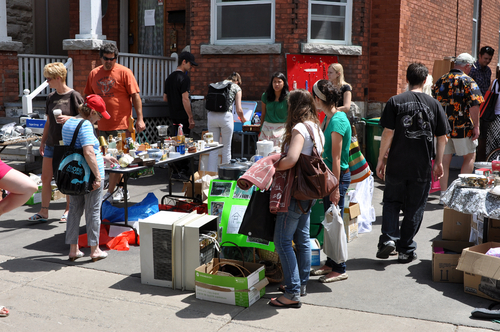
Have you ever heard of a “Really, Really Free Market”? It’s a community event held in a public place where people are invited to bring usable household items and make them available to any attendee to take home at no cost.There is no bartering or swapping. Anyone can take anything they like, for free, with no limits. Thus, stuff is Really, REALLY free. Often, participants also contribute services, talents, or skill instruction freely as well. The website for the Blacksburg, Virginia RRFM home page says: “The RRFM movement is a non-hierarchical collective of individuals who form a temporary market based on an alternative gift economy.”
I attended my first Really, Really Free Market last month in Los Angeles’ MacArthur Park after snagging the e-flyer through a dumpster-diving Meetup.com group. The event was hosted by an anarchist collective, composed of mainly college-age activists. A well-known organization called Food Not Bombs offered free, hot vegan food to everyone, which they traditionally cook from salvaged groceries. I met new people and enjoyed the feeling of fun and camaraderie, despite the park’s usually overcrowded state.
There have been free market events held across the United States (read NPR’s story on RRFMs) and in other countries in the last few years. Some large cities with past or continuing RRFM’s include Pasadena, Santa Barbara, San Francisco, Seattle, Austin, Reno, Minneapolis, Richmond, and Washington, DC. These markets are usually organized by those motivated to empower the citizenry and protect animals and the environment, so don’t be surprised to be offered a petition to sign or a vegan bumper sticker. You’ll also be encouraged to minimize your transit carbon footprint. But, these events include people of all ages and bents, including students, hippies, yuppies, frugals, greenies, dumpster-divers, yard-salers, arty bohemians, the unemployed, the homeless, and the just plain curious.
Wish there was a market in your neighborhood? In theory, it’s not hard to start your own event. You need a central, public space with parking and wheelchair access that is close to public transportation. Restrooms, garbage and water fountains are nice bonuses.
Old-fashioned paper flyers and local word-of-mouth keep the event rooted in the community, but online marketing can be utilized as well, including group boards and social networking services. Inviting a cross section of people from your community will ensure a rich diversity of resources and talents.
You will need a few volunteers to market the event, recruit contributors, set-up the space, clean-up, and supervise. Any items left over at the end of the event can be retrieved by their original owners or donated to charity.
The main requirement is providing space for merchandise display and service stations. Blankets, baskets, chairs, and picnic tables are helpful. Performances may need to be placed on a timed, posted schedule. It’s important to hang a large banner. Typically, there is an element of free food and drink offered by someone at these events.
The two tricky issues in hosting RRFM’s are permission to use public space and liability insurance. Some markets are held without event permits or public food distribution permits. But some groups have been known to rent a private space or request a park party permit. Liability waivers might be an option for those participating. One way to circumvent this issue is to host this as a private event within an established social group, such as a church or community center. You might be able to arrange for the organization to provide their space and offer insurance. One last idea is called a “micro-RRFM”, where a few friends throw a “free yard sale” on their property and give things away to those on their block.
Here is a list of services, skill instruction, and activities that have been photographed at markets around the country: chess games, chair massage, haircuts, bike repair, dance performances, free hugs, artwork, juggling, origami, children’s games, group jump rope, hula hooping, beading, drum circles, stand-up comedy, recipes, balloon animals, letter writing campaigns, tarot card readings, tai chi, plant seedling giveaways, language lessons, poetry reading, face-painting, and puppet shows.
Another option, if you have cooperation from non-profits or city departments, is to allow the distribution of free items at the market to benefit the community, such as water or power-saving devices, compost bins or mulch, instant AIDS health tests or condoms, bicycle or bus maps, library bookmarks, children’s ID kits, or women’s personal safety whistles. The possibilities are endless!
The experience of sharing, receiving, and connecting with the community at your local Really, Really Free Market can be very fulfilling. Whether your event is within legal boundaries or “under the radar”, you might make a friend, find a treasure, munch a snack, finally pass off that white elephant gift, and enjoy a bit of fun, all for FREEEEE!
If you did not read How to run a garage sale, part I, please scroll down two posts for the back story.
The garage sale I ran for my Mom Saturday went well, though some of the really good stuff did not sell. It always amazes me what people will and won’t buy. We had a steady stream of customers from 8:45 a.m. to 10:30 a.m. At 11 a.m. traffic fell off a cliff.
What sold and for how much:
$22 – acoustic guitar with soft case (orig $50 before I realized it had a partially cracked neck)
$5 ea – two bowling balls (to a couple who said they have a “bowling ball garden” in their backyard. Gotta love the funky Berkeley types.)
$.25 ea – dollhouse furniture that was fairly beat up and not too clean after gathering dust for 20 years in my Mom’s attic
$3-$5 – heavy coffee table books
$5 – heat lamp
$20 – mountain bike. After it sold, two more customers said they wanted to buy it. One guy even told me he would have paid $30!
$15 – mini fridge. I had an extension cord to demonstrate it worked.
$4 – solid oak chair painted a tacky baby blue with pink splatters
$1 ea – used pet beds
$1 ea – kids toys
$1 (orig $2 to $3) puzzles and games
$1 – $2 – wood picture frames
Many misc. items
What didn’t sell:
$5 (orig $15) – a breadmaker, even though I marked it down many times. Probably should have started at $8 to $10.
$10 (orig $15) – a brand spankin’ new Cannondale Camelback. I’m carting it back to LA because I’m determined I can sell it.
$.50 to $3 – hardly any of the clothes
$10 – two full size kayak paddles
$5 – tire chains
$3 (orig $5) – Pirates of the Caribbean: curse of the black pearl DVD
$100 – Selmer clarinet (we made the mistake of not listing it in the Craigstlist add)
$1 – cowboy hats
$15 – a plug-in crepe maker
What didn’t sell because I put it aside for myself:
- A pair of gently used Cole Haan black loafers. Score!
- A floppy-brim straw hat that is very lady like
- A wooden hand massager that I can use for a gift
- Two small mason jars that will be great for storing leftovers
- A bright red sushi tray that my neighbor will love
- A red and white floral top
What worked:
- Displaying things on tables and benches so people did not have to get down on the ground to look at items
- Being friendly but not in-your-face
- Accepting most price cuts when customers suggested them
- Group items my category. Originally I recommended folks group items by price. But this only works for small sales. My Mom had enough stuff that it made more sense to group by category – sports equipment, kitchenware, furniture, clothes, books, etc.
- Marking everything with price stickers
- Advertising on Craigslist
What I would have done differently:
- Drop prices earlier. When I cut prices at 11 a.m. it was too late. I should have started dropping prices on items that nobody was showing interest in, like a 4-drawer dresser for $15, at 10 a.m.
In total we sold about half of the stuff. Another 45 percent got picked up by curb crawlers. Once you say something is free, it becomes very valuable!
The last 5 percent I loaded in my Mom’s trunk to take to Goodwill. Our total haul was $217.80. Not too shabby!